How we chose our equipment: 15+ manufacturers and a factory in China
We reviewed 15+ manufacturers from Germany, Italy, China, Turkey and Poland, tested the washes available in our region first-hand, and inspected LeisuWash's factory on-site. Here's why we chose them.
Before we washed a single car, we spent months on a question most operators never really ask: which machine should we trust with thousands of customers' paint, around the clock, for years? RoboSpa was never meant to be "a car wash with an app bolted on." We wanted a platform — hardware and software working together — that could run 24/7, stay open while the technician is asleep, and treat every car's finish as if it were our own. That meant the equipment decision came first, and we refused to rush it.
What follows is the honest version of how we chose. It involved spreadsheets and reference calls, but also flights, factory floors and a lot of standing in other people's wash bays watching water hit metal.
More than 15 manufacturers across five countries
We started wide. We reviewed more than fifteen car-wash equipment companies from Germany, Italy, China, Turkey and Poland — the established European names with decades of brand equity, the high-volume Asian manufacturers, and the regional players in between. For each one we built the same scorecard: wash quality and paint safety, mechanical reliability, the real cost of maintenance over a decade, spare-parts availability and lead times, and how much of a fault could be diagnosed and fixed remotely versus needing a service van on site.
A few patterns emerged quickly. The premium European brands build excellent machines, but their parts and service carry a premium to match, and lead times for a component from abroad can idle a bay for days. Some of the cheapest options looked attractive on the quote and alarming on the maintenance schedule. What we were hunting for was the rare combination: genuinely modern engineering, serious paint care, and an ownership cost that still made sense at the scale we were planning.
We tested what was already on the road
A datasheet tells you what a machine is supposed to do. It does not tell you how a five-year-old unit actually behaves on a cold morning with a queue forming. So before we committed to anything, we went and used the comparable washes already operating in our region — as ordinary customers, paying for the wash, watching closely.
We looked at the things owners learn to ignore and customers feel immediately: how evenly the car came out, whether the wash left swirl-free paint or a faint haze, how long a full cycle took, how the machine handled an SUV versus a low sports car, and how it sounded — because a machine that screeches and judders is a maintenance bill waiting to happen. That first-hand experience set a clear, unsentimental bar that no brochure could have given us. It also sharpened our conviction about one thing in particular: for personal cars, contact brushes were off the table. (We wrote about why in touchless vs brush car washes.)
What we were really optimising for
By the time we narrowed the field, our priorities had crystallised into four non-negotiables.
- Paint safety, first and always. A wash that scratches is worse than no wash. The machine had to clean thoroughly without anything abrasive touching the finish.
- Uptime. An unmanned, 24/7 site only works if the equipment almost never strands a customer. We needed remote diagnostics, predictive maintenance and fast parts — not a business model built on hoping nothing breaks.
- Software that improves over time. Most car-wash software is frozen the day it ships. We wanted a platform that could get better through updates, the way a phone does.
- A partner, not just a vendor. Warranty, training, responsiveness and a roadmap mattered as much as the spec sheet, because we were buying a ten-year relationship.
What "reliable" has to mean at 24/7
When a wash is staffed, a jam is an annoyance someone walks over and clears. When it's unmanned and open at three in the morning, the same jam is a stranded customer, a refund, and a bad review. That changes what "reliable" has to mean. We weren't looking for a machine that rarely breaks in a brochure sense; we were looking for one that fails gracefully — that catches a problem early, tells us before it becomes a stoppage, and can be brought back without a technician driving across the city. A platform that phones home, runs self-checks between washes and lets us see every sensor remotely turns reliability from a hope into something we can actually manage. That requirement quietly eliminated a lot of otherwise-capable machines that simply weren't built to be watched from afar.
The cost that doesn't show up on the quote
The sticker price of a wash machine is the easiest number to compare and the least useful. What actually determines whether a site makes sense over ten years is everything the quote leaves out: how often consumables and wear parts need replacing, how much a common spare costs and how long it takes to arrive, how many hours of downtime a typical fault causes, and how much skilled labour each service visit demands. We modelled all of it. A machine that's a little cheaper up front but eats a weekend of lost revenue every time a part fails from abroad is not cheaper — it's a slow leak. LeisuWash's combination of standard industrial components, remote resolution of most issues, and fast parts availability is what made its true cost of ownership add up, not just its quote.
Built for a network, not a single bay
We weren't choosing equipment for one location; we were choosing the foundation for a network of sites that all had to behave the same way. That raised questions a single-bay buyer never asks. Could we see every site from one dashboard? Could we roll out a tuned wash program to all of them at once, instead of reprogramming each machine by hand? Would a customer get the identical wash in one neighbourhood as in another? Hardware that's open, networked and updatable makes a consistent, centrally-managed network possible; closed, offline hardware makes it a manual chore that gets harder with every site you add. Choosing for the network, not the bay, pointed us firmly toward a platform we could operate as one system.
A factory visit in China
You can learn a lot about a manufacturer from what they're happy to show you. So we flew to LeisuWash in China and inspected production on-site rather than taking anyone's word for it. We wanted to see the components going into the machines, not just read about them: Delta servo drives, Siemens PLC control, and original European peripherals on the parts that matter — the same names we'd trust in any serious piece of industrial automation.
We watched the quality-control process, looked at how units were assembled and tested before shipping, and gauged the production capacity behind the brand — because a supplier who can't scale becomes a bottleneck the moment you want to open your next site. Standing on that floor turned an abstract purchasing decision into something concrete. We left confident that the machines we'd be putting in front of customers were built to a standard we could stand behind.
Why LeisuWash won
LeisuWash is among the most innovative manufacturers in the field, with installations in more than 100 countries — but installed base alone didn't decide it. Four things did.
First, AI three-axis motion control. The machine senses the exact shape of each vehicle and moves its arms in three axes to follow the body precisely — close enough to clean well, never close enough to risk contact. That precision is the heart of safe touchless washing.
Second, remote diagnostics that actually work. Up to 90% of issues can be identified and resolved remotely, which for an unmanned 24/7 operation is transformative: most problems are fixed before a customer would ever notice, and a physical call-out becomes the exception, not the routine.
Third, over-the-air software updates. The wash programs, the motion logic and the control software can all be improved remotely, so a site we open today keeps getting better long after installation — the opposite of hardware that ages into obsolescence.
Fourth, a 3-year warranty on the industrial series, backing all of the above with a commitment that matched our own time horizon.
The software half of the platform
Choosing LeisuWash settled the hardware question, but only half the platform lives in the bay. The other half is the software we built around it: the app that lets you start a wash, pay and earn loyalty without a queue or an attendant; the back-office system that watches every site in real time, flags a pump or sensor drifting out of spec before it fails, and lets us push a better wash program to every location at once. Pairing LeisuWash's open, update-friendly machines with our own software is what turns a row of good hardware into a network that gets smarter and more reliable the longer it runs. It's also why the equipment's remote-diagnostics and OTA capabilities weren't a nice-to-have for us — they were the features that made the whole RoboSpa model possible.
The technology that actually protects your paint
It's worth being concrete about why this combination matters to the person whose car is in the bay. The AI motion control is what makes a genuinely contact-free wash possible at speed: high-pressure water and active foam do the cleaning, guided arms keep perfect distance, and nothing solid ever drags across the clear coat. No brushes means no swirl marks, no embedded grit, and none of the broken mirrors or snapped antennas that contact washes are notorious for. The software and diagnostics, meanwhile, are what keep that precision calibrated wash after wash, so the hundredth customer of the day gets the same careful treatment as the first.
See it for yourself
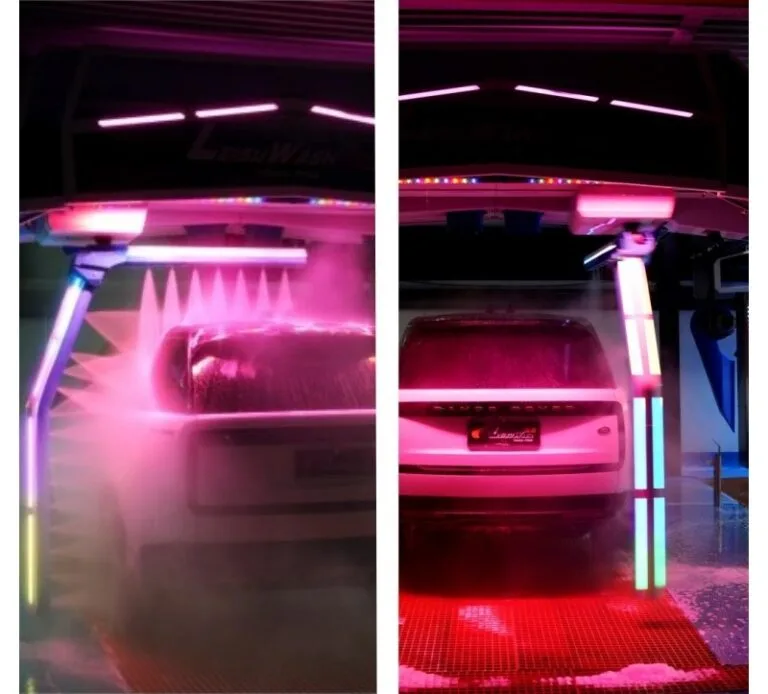
It's one thing to read about a machine and another to watch it work. Here's the LeisuWash platform in action — the same kind of system we put on our sites:
A few questions we get asked
Why not a European-built machine? We seriously considered several, and they make excellent hardware. In the end the decisive factors were total cost of ownership, parts lead times, and how much could be handled remotely — and on those, the LeisuWash platform fit our 24/7, multi-site model better.
Is "made in China" a compromise on quality? Not when you inspect what's inside. The machines run Delta servo drives, Siemens PLC control and original European peripherals on the critical parts. We went to the factory specifically so we wouldn't have to guess.
Does the equipment lock you into one supplier? Open, updatable software was a requirement precisely so it wouldn't. The machines run our own system rather than being trapped inside a vendor's closed platform.
How does this help me, the customer? Indirectly but completely: it's why the wash is open whenever you need it, why it cleans consistently, and why nothing ever touches your paint.
Touch-free was the starting point, not the conclusion
It's worth saying plainly: we didn't pick a brand and then decide touch-free was good. We started from the conviction that nothing should scrape a customer's paint, and then looked for the equipment that could deliver a genuinely contact-free wash reliably, at volume, for years. LeisuWash earned the decision by meeting that standard and the operational ones at the same time. If you want the full argument for why contact-free matters so much, it's in our piece on touchless vs brush car washes — this article is the story of finding the machine that lives up to it.
The bet we were making
Choosing equipment for a business you intend to run for a decade is, in the end, a bet about the future. We were betting that unmanned, software-driven, paint-safe washing is where the market is going — and that the right partner is one whose machines get better after you buy them, not worse. Everything in this process was really about de-risking that bet: testing rivals so we weren't guessing, visiting the factory so we weren't trusting blind, and insisting on remote diagnostics and updates so a problem at 3 a.m. wouldn't become a crisis. We can't promise the future, but we made the most informed bet we could — and so far, every site we've opened has reinforced it.
What this means for you
Most of this research is invisible from the customer's seat — and that's the point. You pull in, the lights guide you forward, the arms move around your car, and a few minutes later you drive out clean, with paint exactly as untouched as when you arrived. The months we spent comparing manufacturers, testing rivals and walking a factory floor all collapse into one simple promise at the bay: a wash you can use every week for years without ever paying for it in scratches. That's why we build RoboSpa on LeisuWash equipment and our own software — the same combination we put into our own sites, and the reason we're comfortable standing behind every wash.
Ready to try it?
5 sites in Sofia, 5 programs, 24/7 at all locations. Your first wash is −20% through the app.
Download the app