Touchless vs brush car washes — what protects your paint?
Micro-scratches, swirl marks, and why touchless washing is the standard for new cars.
Touchless washing relies on high-pressure water jets and active foam alone — no brushes or fabric ever touch your paint. It sounds almost too simple: how can water get a car as clean as something physically scrubbing it? Yet for modern cars — clear-coated, metallic, often wrapped or ceramic-coated — touchless is not just a gentler option. It is the only method that cleans the car without slowly destroying the surface you paid for. This article explains exactly what a brush does to paint, the mechanical damage that rarely makes it into the brochure, and why we built every RoboSpa bay around touchless technology. If you're curious about the hardware itself, we wrote separately about the wash platform we chose and why.
What a brush actually does to your paint
A car's paint is not a single layer. Under the colour sit primer and bare metal; over it sits a thin, transparent clear coat — usually 40–50 microns, thinner than a sheet of paper. That clear coat is the only thing standing between the sun, road salt, bird droppings and the pigment underneath. Its job is to stay glossy and intact for a decade or more.
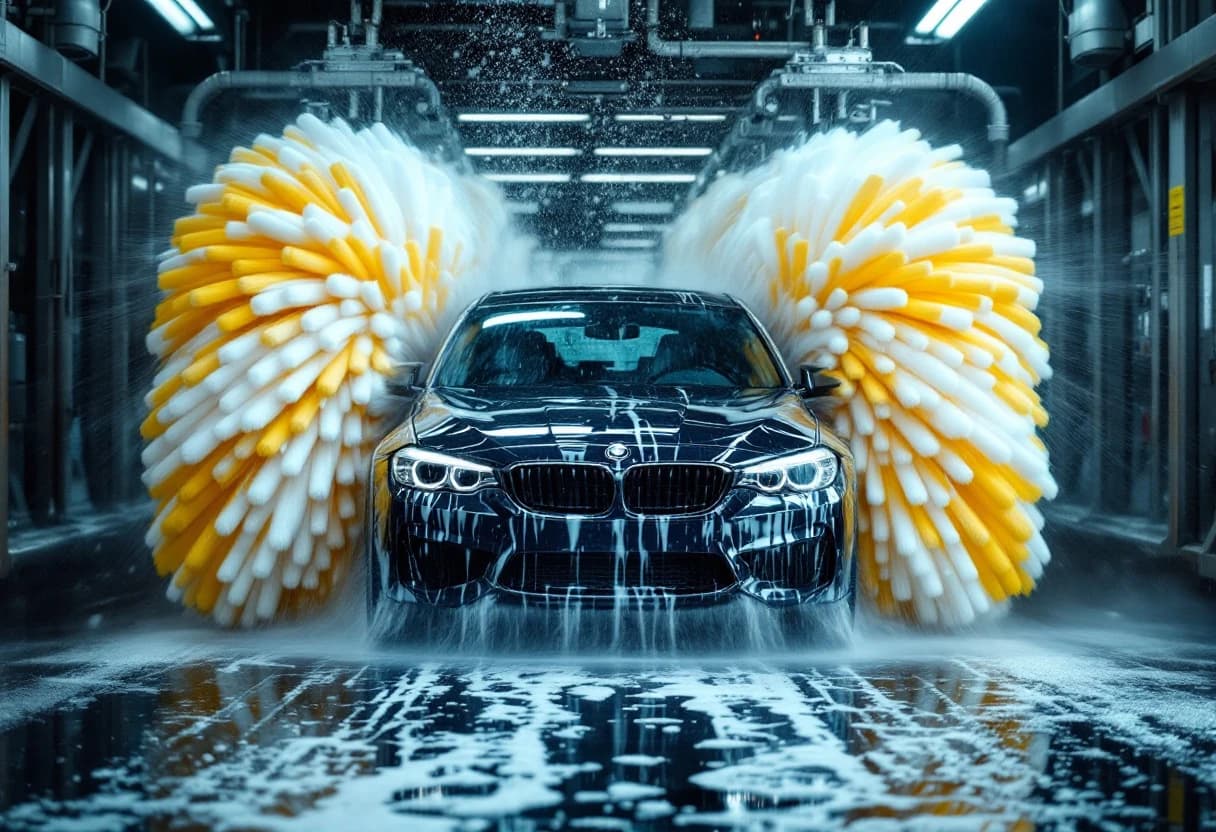
A spinning brush works by dragging stiff bristles or foam strips across that surface under pressure. On a perfectly clean brush touching a perfectly clean car, the damage would be minimal. But a car-wash brush is never clean. It has just scrubbed the car ahead of you, and the one before that — pulling off road grime, baked-on brake dust, sand and tiny stone fragments. Much of that debris stays trapped in the bristles and is then dragged across your paint at speed. You are, in effect, being polished with the dirt of every car that came before.
Swirl marks and micro-scratches, explained
The result is what detailers call swirl marks: thousands of fine, shallow scratches that fan out in circular patterns. Each individual scratch is microscopic, but together they scatter light. That is why a car that looks fine in the shade suddenly shows a hazy, cobweb-like halo around every light source in direct sun — and why the effect is so brutal on black, dark-grey and dark-blue cars, where there is no light paint colour to hide it.
Swirl marks are not just cosmetic. Every scratch is a tiny breach in the clear coat that gives moisture, salt and contaminants a place to start working. Over years of weekly brush washes, a car loses depth and gloss, the clear coat thins unevenly, and what should have been a ten-year finish starts to look tired in three or four. Polishing can mask swirls temporarily, but polishing also removes clear coat — so you are trading one form of wear for another. The only real fix is not creating the scratches in the first place.
Broken mirrors, snapped antennas, and torn wipers
Micro-scratches are the slow, invisible damage. The faster, more painful damage is mechanical — and anyone who has used automatic brush washes for years has either seen it or had it happen.
Brushes and gantries apply real force, and they cannot tell the difference between a flat door panel and a part that sticks out. The classic casualties:
- Side mirrors — folding mirrors that should have been tucked in get caught by the brush and bent back hard, cracking the housing or shattering the glass. On cars with power-folding mirrors that didn't retract, the motor and hinge take the hit.
- Antennas — a fixed roof antenna is exactly the kind of thin, protruding part a horizontal brush snaps clean off or whips sideways until it breaks at the base.
- Wiper blades and arms — brushes lift, twist and tear wiper blades, and can bend the arms out of alignment so they no longer sit flat on the glass.
- Trim, badges and spoilers — loose or aftermarket trim, emblems, roof-rack feet and lip spoilers get caught and peeled away. Rubber door and window seals can be rolled and torn.
- Wraps and aftermarket parts — vinyl-wrap edges and add-on body kits are especially vulnerable to lifting.
None of this is rare. It is the predictable outcome of pushing stiff, fast-moving bristles against parts that were never designed to take a sideways blow. And because the damage happens inside an automated cycle, you usually only discover it when you drive away.
Why it happens: recycled grit and blind force
Two things make brushes risky no matter how modern the site looks. The first is grit recycling: the same bristles touch hundreds of cars between deep cleans, so abrasive particles are always present. The second is that a mechanical brush applies force blindly — it follows a programmed path or simple sensors, not a real understanding of where your specific mirror, antenna or spoiler is. Soft-cloth and foam washes are gentler than old nylon bristles, but "gentler" is not "safe": they still hold grit, and they still apply pressure to parts that protrude.
How touchless washing works
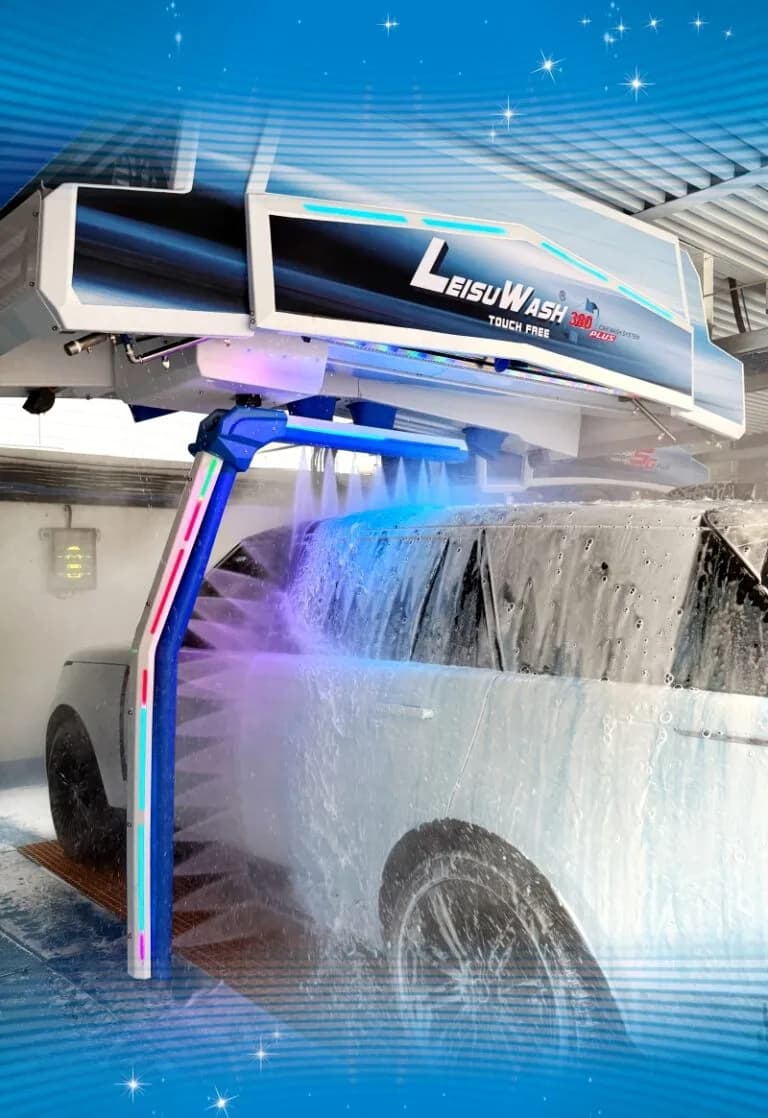
Touchless washing removes the brush from the equation entirely and lets chemistry and water pressure do the work. In a RoboSpa bay, the cycle runs in stages. First the car is coated in an alkaline pre-wash foam at pH 11–12, which chemically breaks the bond between the paint and the layer of grease, traffic film and asphalt particles stuck to it. The foam is given dwell time — around 60 seconds — to do its job, so the dirt is already loosened before any water hits it.
Then high-pressure jets at roughly 100 bar rinse everything away. Because the dirt has been chemically released first, the water doesn't need to scrub — it simply carries the loosened grime off the surface. Nothing solid ever touches the paint, so there is no mechanism to create swirl marks and nothing to catch a mirror or antenna. The same precision that protects the paint is why we were so careful about the equipment itself — read about how we chose this platform and the AI-guided motion control behind it.
"But does touchless really get the car clean?"
This is the honest question, and the honest answer is: yes, when it's done properly. Touchless gets a bad reputation from cheap setups that skimp on chemistry, use weak pumps, or rush the dwell time — and those do leave a film. A correctly run touchless cycle, with the right alkaline and acidic pre-treatments, the correct dwell time and genuine high pressure, removes normal road dirt completely.
What touchless will not do is grind off a thick, dried-on layer that has been baked on for months — but neither will a single brush pass without scratching the paint to get there. For the everyday reality of a daily-driven car, touchless is more than enough, and it does it without leaving a single new scratch behind. The trade-off is firmly in your favour.
New cars, metallic paint, and ceramic coatings
The case for touchless gets stronger the more you care about the car. New cars have their full, original clear coat — exactly the thing you want to preserve, and exactly what a brush starts thinning from day one. Metallic and pearl finishes show swirl marks more readily because of the way the flake reflects light. And if you have paid for a ceramic or graphene coating, running it through a brush is self-defeating: the brush abrades the very coating you installed to protect the paint, and grit dragged across it can scratch straight through.
For leased cars there is a financial angle too: swirl marks and brush damage show up at end-of-lease inspections and come out of your pocket. Keeping the finish genuinely untouched protects resale and lease-return value, not just looks.
When is a brush car wash still OK?
Brushes are not evil — they are simply the wrong tool for paint you want to keep looking new. There are cases where they make sense: heavily soiled work vehicles, trucks, vans and construction equipment where the paint is already a working surface and appearance is secondary to getting mud and grime off quickly and cheaply. For a fleet of site vehicles, a brush tunnel is a reasonable trade-off.
For a personal car — especially a new, metallic, wrapped or ceramic-coated one — the maths is different. The few minutes and small saving a brush wash offers are not worth a decade of accumulating swirls and the risk of a snapped antenna or cracked mirror.
How to tell which wash you're actually using
Not every "automatic" wash is the same, and the signs are easy to read once you know them:
- Brush / soft-cloth: you'll see large vertical rollers and a horizontal top brush, often with coloured foam strips. If something physically folds down onto the roof, it's a contact wash.
- Touchless: you'll see only nozzles and arms spraying foam and water — an arch or a robot that moves around the car without anything touching it. RoboSpa bays are fully touchless.
- "Brushless" labels: treat them with care. Some sites use the word loosely. The only thing that matters is whether anything physically contacts the paint.
If you're not sure, the safest assumption is simple: if it touches, it scratches.
Hand washing isn't automatically the safer answer
Many people assume that if brushes scratch, washing by hand must be the gold standard. It can be — but only with the right technique. The most common cause of swirl marks on enthusiast cars is not an automatic wash at all; it's a dry sponge, a single bucket of increasingly dirty water, and a circular wiping motion that grinds grit into the paint. Done badly, hand washing scratches every bit as much as a brush.
Doing it safely means a pre-rinse to flush off loose grit, a foam pre-soak, the two-bucket method with a grit guard, soft microfibre mitts rinsed often, and straight-line motions — then a careful, contact-free dry. That is a lot of time, water and discipline for every wash, every week. A properly run touchless cycle gives you the no-contact safety of a meticulous hand wash without the half-hour of effort, and without the risk that one rushed wash undoes months of care. For most people, that consistency is the real advantage.
The ten-year view
It helps to think in years rather than single washes. A car washed weekly sees more than 500 washes over a decade. With brushes, that is 500 chances to add swirls, embed grit and catch a mirror or antenna — damage that compounds, because each pass works on a surface the last pass already roughened. With touchless, it's 500 washes that leave the clear coat exactly as they found it.
The difference shows up where it costs you: in how the paint looks under the showroom lights when you sell, in whether a leasing company flags the finish, and in whether a ceramic coating you paid for is still doing its job after three years or has been quietly abraded away. Choosing how you wash is really choosing how your car ages. Touchless is the option that lets it age slowly.
Common questions, quickly answered
Will touchless damage a soft or matte finish? No — with nothing touching the surface, there is nothing to burnish a matte wrap or scuff delicate paint. That is exactly why matte and satin finishes, which must never be polished, are best kept to contact-free washing.
Is it bad for the car in winter? The opposite. Winter is when road salt does the most harm, and the worst thing you can do is grind salt crystals across the paint with a brush. Touchless flushes salt out of seams and off the surface without dragging it anywhere.
What about the wheels and lower body? A good touchless program targets the wheels and sills with dedicated chemistry and angled jets, where the heaviest brake dust and grime sit. These are also the areas a brush reaches least evenly.
Do I need to fold my mirrors or retract the antenna? With touchless, no — there is nothing to catch them. The habit of folding mirrors and removing antennas exists precisely because brush washes break them. Remove the worry and you remove the ritual.
The bottom line
Brush washes clean by abrasion, and abrasion always has a cost: micro-scratches that dull the finish over time, plus the real, immediate risk of broken mirrors, snapped antennas and torn wipers when stiff bristles meet parts that stick out. Touchless cleans by chemistry and pressure, so the paint is never touched and there is no mechanism for that damage to occur. For the cars most people drive today, that is not a luxury — it is simply the correct way to wash. It is the reason every RoboSpa bay is touchless from the ground up, built on the equipment we chose specifically to protect your paint.
Ready to try it?
5 sites in Sofia, 5 programs, 24/7 at all locations. Your first wash is −20% through the app.
Download the app